What Does “Climate Emergency” Action Mean?
The National Climate Emergency Summit, held in Melbourne on February 14-15, was a timely and important event. The Sustainable Living Festival pulled off an impressive feat organising it, filling Melbourne Town Hall to absolute capacity, getting a huge number of people inside and outside the rooms talking about the fact that we are in a climate emergency and asking what to do about it. But, in many ways, the summit raised more questions than it answered, and exposed just how enormous the task in front of us is.
It was a privilege to take part in a couple of panel discussions at the event, on democracy and climate emergency action, making the argument I present in this recent piece in Meanjin: that our current democratic systems are both incapable of tackling the interconnected crises we face and tragically ill-suited to enabling survival, as well as setting out a vision and a clear path for a grassroots, participatory, cooperative democratic practice to emerge from the ashes.
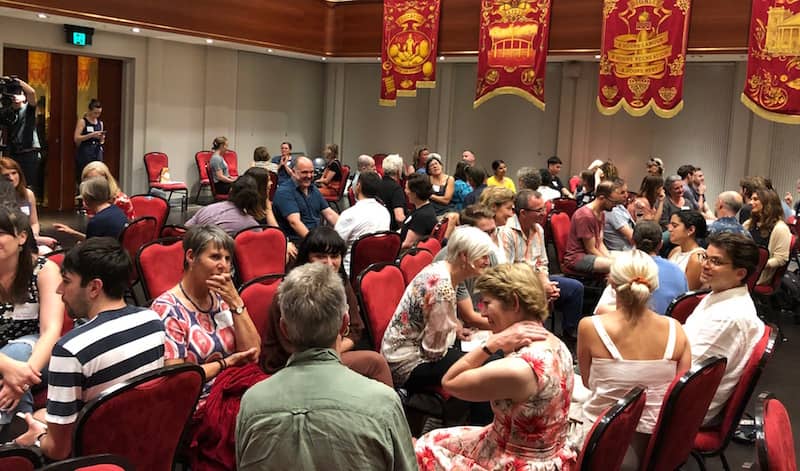
The pre-summit panel, Democracy Is Not A Spectator Sport, included active audience discussion as a quasi-people’s assembly. The conversations were challenging, inspiring and truly transporting, giving everyone involved a deep sense of what it might mean to cultivate a different way of doing democracy, from the grassroots up. It was clear from that event, as well as a range of panels and numerous conversations with attendees in the corridors and over coffee, that people are absolutely craving agency, desperate for collective action which matches the scale of the climate threat, builds better lives for all of us, and doesn’t rely on a moribund political system.
That tremendous tension between the need for emergency climate action and the increasingly obvious fact that our political system will not and cannot deliver it sat over the summit like an imminent thunderstorm that refuses to break. When I asked the 150+ audience members in the Citizen Act panel if they believed that governments would take climate action on the scale and at the speed the science demands, not a single person raised their hand. You could cut the air with a knife as people confronted in themselves the implications of that conclusion. On a handful of occasions this tension exposed rifts which run very deep indeed. It’s my opinion that we have to draw this to the surface and have an open discussion as soon as possible after this summit: what do we mean by climate emergency action?
As a prelude to discussing the divergence of views of what climate emergency action looks like, it’s worth highlighting the very valid critique of the inadequate diversity of speakers on the plenary stage and fronting the media, as Ketan Joshi notes here and many others have raised. Diversity is, in an ecological sense, a good in and of itself, and a lack of diversity – a monoculture – is a recipe for disaster. A healthy discussion should hear from a range of voices with a range of experiences, and enable critical conversation amongst them. The fact that individuals such as Peter Garrett, John Hewson, Tim Costello, Paul Gilding and Ian Dunlop were part of the conference is good. The fact that they dominated the plenary stage, with some of them appearing several times, meaning there was less room for other voices, was a problem. Other than the Welcome to Country, Lidia Thorpe was the sole Indigenous voice on the plenary stage, appearing once as part of a huge panel, and the single First Nations panel was shunted to a side room, meaning crowds of attendees (including me) were turned away. (Wonderfully, the fact that there was not enough space to accommodate the people who wanted to hear from this panel demonstrates that the audience is ready to listen to the people who have carefully stewarded this country for tens of thousands of years!) Nyadol Nyuon and climate striker Jean Hinchcliffe had a few moments each in plenary, compared to multiple appearances from the older white men.
The issue isn’t just that these people had their chance to create change, squibbed it, and are offering little if anything in the way of new thinking which might suddenly make their old failed strategies succeed. In that light, the panel entitled Rebooting Democracy, featuring Peter Garrett, John Hewson and Zali Stegall, for example, was a tremendous missed opportunity to hear from people with fresh ideas for how democracy might be rebooted instead of a rehashing of old arguments by people who insist that our democratic systems are fine as they are, we just need the voters to elect better representatives.
The far bigger problem, however, was that the kinds of solutions to a climate emergency that people who have lived lives of unquestioned privilege bring to the table can be, shall we say, problematic. Nyadol Nyuon nailed that point in words to the effect of “climate justice is just an ideal for those who might lose their privilege, but it’s an absolute necessity for survival for the rest of us.”
I was dreading, but not necessarily expecting, the only half-joking suggestions in the Hypotheticals-style panel from Paul Gilding and Ian Dunlop that we may have to temporarily suspend democracy and civil liberties in order to achieve the scale of change necessary. I was not amused by the quip about building a wall across the Queensland border when it becomes a failed state after the collapse of both the coal industry and the Great Barrier Reef. I was relieved when Carmen Lawrence and Lidia Thorpe dragged the conversation back to the failure of our current democracy and the fundamental need for justice to be at the heart of any true climate response, but disappointed when they weren’t given the space to truly debate what a suspension of democracy might mean.
But the next morning I was in for a shock. Outside the context of a deliberately light-hearted and provocative Hypotheticals panel and in the cold light of day, Tim Costello declared that, while he was aware of the risks of government-led emergency action, his opinion was that humans can survive tyranny but cannot survive the climate emergency, so we should be willing to leave open the option of suspending democracy. Phillip Sutton swiftly followed to note that we need “more and better democracy not less”, but there was again no debate on the stage about the implications of Costello’s statement.
As the child of refugees and grandchild of Holocaust survivors, I grew up with family stories of the loss of democratic rights and civil liberties, and the very dark path indeed that that leads to. But it doesn’t take a great knowledge of history or a particularly difficult task of empathy and imagination to recognise that these ideas leave the door open to eco-fascism. It is genuinely not far-fetched to imagine governments in the near future suspending planning laws to ram through construction of nuclear power stations on the outskirts of cities, and waste dumps on Aboriginal land; enforcing energy efficiency by cutting power supplies to poorer areas for hours each day; banning all protest and enforcing broad social compliance through militarised policing; closing the borders and deporting or imprisoning undesirable people in a population control exercise.
This is what I call the “Margaret Atwood scenario”. It’s scary because it is completely plausible. Like Atwood says of The Handmaid’s Tale, all of the aspects of this story have been implemented somewhere already. It could happen here.
To be clear, I am not for a second suggesting that this scenario is what any of the speakers at the summit had in mind, nor that they would be anything other than appalled by that outcome. But, as a climate movement, we must be concerned with justice, and we must name this very real possibility of authoritarianism and fight against it with all that we have. It is not a solution. It is not an option we can accept. Apart from anything else, the fact that it is driven by values of disconnection and dominance mean that it can never truly be part of an effort to heal the biosphere, and as such will fail to tackle the climate and ecological crises. It may simply slow the arrival of the end of the world for a select few. With so many deeply bad faith actors like Peter Dutton already looking for every excuse to implement more draconian and authoritarian laws, we in the climate movement must not leave the door open even a crack.
It’s a relief that the Climate Emergency Declaration released at the end of the summit includes reference to the necessity of democracy and Indigenous rights, although the lack of consultation on that Declaration shows in the inclusion of Constitutional recognition as a marker of the latter – something Indigenous communities are increasingly vocally opposed to.
This lack of consultation points to my only other disappointment with what was in many ways an excellent and vital event – that it was more a conference than a summit. It was, on the whole, an opportunity for a select few (myself included) to talk to audiences. There was very little opportunity for practice of what I and quite a few other speakers on side panels believe is the only real answer to this crisis – deepening democracy through participation, deliberation, and radical collective action.
This is the crux of the divergence of opinions around climate emergency action. The top down approach, which was centred by this summit, at its best is magical thinking which assumes that politics as usual can fix the climate crisis, without providing any new strategy to make that happen. At its worst it opens the door to ecofascism. But there is another approach, a bottom up, grassroots, community building approach that rebuilds democracy and cultivates new forms of cooperative power.
There were excellent conversations about that bottom up approach around the summit, including Jane Morton’s call to “supplement representative democracy with deliberative democracy”, Margaret Klein Salamon’s examples of grassroots action in the USA, school strikers discussing their approach, Leigh Ewbank from Friends of the Earth explaining their consensus-based distributed campaigning model, numerous examples of kitchen table conversation projects, and a brilliant panel on local government (including ACT) action. I understand that a parallel meeting of local government representatives developed the beginning of an exciting collective project that could drive some very exciting change. I also want to recognise wonderful presentations from Anika Molesworth from Farmers for Climate Action, journalist Paddy Manning who is writing a book on the body count from the climate emergency, the always brilliant Christine Milne, Sam La Rocca from Sunrise, and scientists Michael Mann, Charlie Veron and David Lindenmayer. There was a tremendous amount to digest at the summit – much food for thought for everyone who attended.
We are well and truly in a climate emergency right now, and calls for climate emergency action will only grow louder. In this context, it is vital that we critically engage with what that means.
If we want emergency scale and speed action and we do not believe that our governments will deliver that (and another major study just found that the summer’s fires have led to a further crashing in confidence in not just our governments but in our systems of government), our only real choice is to immediately bring together the collective grassroots action which can radically reduce emissions, build social cohesion, and cultivate the new democratic norms and institutions that will enable us to not just survive but thrive.
If you’d like to be part of the conversations and projects the Green Institute runs in building this vision, sign up to our email list here.
